
Following our article on David Harvey, we spotlight the other elite Scots goalie who in the 70s, chose to play for Scotland despite genuine prospects of playing for England. This is a player who was instrumental in Arsenal winning their first UEFA trophy & also a same-season league & FA Cup double. Yet fate meant he had only a brief international career. This is the story of Bob Wilson.
Bob Wilson background
Bob Wilson was born in a house named “Threepwood” on Ashgate Road in Chesterfield in 1941. The house was named Threepwood as part of the family’s East Ayrshire heritage. Some sources claim Wilson’s dad, William, was born at Threepwood farm near Galston. However, Bob himself is quoted as stating:
“My mum was born to a farmer in Galston and my dad was from Darvel and were incredibly proud Scots, and any holidays we had started in Galston and went on to Perth, where my [maternal] uncle John was Lord Provost for several years.“
Also on his mum’s side, his Great Uncle John was the Lord Provost of Glasgow who officially opened Hampden Park in 1903. That same Great Uncle was also a chairman of Rangers.
Bob was youngest of 6 siblings. His brother, Jock was a Spitfire pilot, killed in action in WW2 when 19 years old. Another brother, Billy, flew in Lancaster bombers as a rear gunner, & was killed in action when he was 20.
Early days in football
Bob Wilson played for the England Schoolboys in 1957. He & Nobby Stiles consequently were the 2 players in that team who Matt Busby at Manchester United keenly wanted to sign. Busby showed Wilson & his dad around the ground, with the young GK eager to sign. Wilson senior though was having none of it, insisting:
“You’ve got to get a proper job first, son, and if you still want to be a footballer, I might give you my blessing.”
Wilson was sufficiently emotionally attached to the Old Trafford side to have been inconsolable at the time of the Munich air crash in 1958.
In response to his dad’s insistence of ‘getting a proper job’, Wilson thus went to Loughborough College for 3 years on an education course, studying PE & history. While there, Wilson played as an amateur for both the British Universities team & Wolverhampton Wanderers reserves. Arsenal physio, Bertie Mee, was also the physio for the Universities team. Mee connected Wilson with Billy Wright who was Arsenal manager at the time. It was Wright who signed 21 year old Wilson for the Gunners in July 1963.
Fearless Bob Wilson
Wilson for better or worse, modelled his style of play on Manchester City’s extraordinary Bert Trautmann. Trautmann was the Football Writer’s Player of the Season for 1955-56. Trautmann entered football legend in the 1956 FA Cup final. 17 minutes from full time, Trautmann dived head first at the feet of Peter Murphy of Birmingham City. Trautmann seriously injured his neck in doing so, but played on holding his neck in between making further important saves. Final score, Man City 3, Birmingham City 1. Ex-Hibs Bobby Johnstone scored for Trautmann’s team, in doing so becoming the first player to score in 2 consecutive FA Cup finals. 3 days after the final, an x-ray showed Trautmann had a broken bone in his neck.
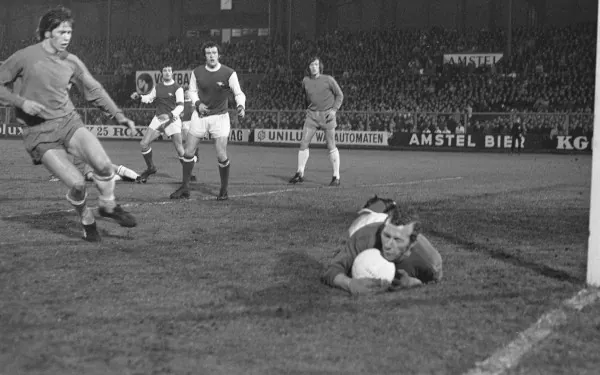
Bob Wilson was an excellent shot stopper, athletic, agile, determined & very hardworking. He was also a very vocal organiser, barking out orders at his teammates. However, the attribute for which he was most renowned was best summed up by Mee:
“Bob Wilson was one of the bravest goalkeepers I ever saw. He threw himself at forwards’ feet without a moment’s hesitation. He was absolutely fearless.”
Wilson consequently endured a torn ear, a punctured lung, a number of shattered ribs and a broken arm among his injuries in his playing career.
Bob Wilson at Arsenal
Nicknamed Willow, Wilson debuted competitively for the Arsenal first team in October ’63, in a 4-2 home win over Nottingham Forest. Such was Wilson’s unique situation, he was still an amateur at the time, the last to play in England’s top tier.
Wilson made only 10 first team appearances in his first four years at Arsenal. He was a much more familiar character playing for the reserves during which time he also completed his teacher training. He did not become regular first choice until March 1968, by which time Bertie Mee was Arsenal boss.
1st team regular
Wilson won his first senior trophy in 1970, the Inter Cities Fairs Cup (today re-branded as the Europa League), defeating Ajax 3-1 on aggregate in the semifinals & Anderlecht 4-3 in the 2-legged final. That was Arsenal’s first major trophy win in 17 years.
The season after was Wilson’s best. In 1970/71, Arsenal beat Don Revie’s formidable Leeds United by one point to clinch the league title. Liverpool were the only side to concede fewer goals than Arsenal’s 29 in that league campaign.
Further, the Merseysiders were the Gunners’ opponents in that 1971 FA Cup final. Wilson was in great form, in a game that went to extra time, saving the day numerous times for a 2-1 win. He was the star GK of the Arsenal team side in 1970-71, that was only the 2nd team in the 20th century at that point to win the league & FA Cup double. Wilson was ever present that season in both of those 2 competitions. Wilson was Arsenal’s Player of the Season, all the more impressive in a league & cup double winning season. His Arsenal captain, CB & fellow Scot, Frank McLintock, won the Football Writers Player of the Season award.
In defending the FA Cup, Wilson picked up an injury in the April 1972 semifinal win against Stoke City. The injury kept him out of the first team for 7 months, meaning he consequently missed the 1972 FA Cup Final. In his absence, Arsenal lost that final 1-0 to the Leeds side featuring David Harvey in goals & Eddie Gray at LW. Although Wilson didn’t realise at the time, that injury subsequently had a terminal effect on his Scotland career.
Bob Wilson for Scotland
Eligibility
In the early part of Wilson’s playing career, FIFA eligibility rules meant he could only play for the nation of his birth. That though changed with what is sometimes informally referred to as the 1970 rule change. Specifically, FIFA approved expanding eligibility to encompass parental nationality. As Wilson later said in a Press Association interview:
“I was on holiday abroad and a Scotsman came up to me and said, ‘you’re one of us now, they’ve changed the rules.'”
“If it’s about the blood in your body, I am 100 per cent or more Scottish.”
It is less clear when the new rules were ratified & thus finally took effect. However, what can be stated with certainty is that both Wilson & Hibs’ Alex Cropley were among 4 debutants in Scotland’s first Autumn game in 1971. Like Wilson, Cropley was born in England, in Cropley’s case in Aldershot where his dad, Jack, was playing for the football club of the same name.
Scotland debut
Scotland defeated Portugal 2-1 in that Euros qualifier at Hampden. John O’Hare & Archie Gemmill scored in what was Tommy Docherty’s first game as Scotland boss. Wilson said:
“I can remember Tommy, a real character, being at Arsenal one night, and sort of hinting. I was at the peak of my career. We had won a European trophy, the league and the cup double, and the fans voted me player of the year. So I thought there was a massive chance it would happen.”
“I was incredibly nervous and I can remember standing in the tunnel and Eusebio winked at me. Somebody must have said that Scotland has got a nervous keeper. When I ran to the goal, the reception was incredible. That was one of the things that got me through it. Not just for me, but for my mum and dad and uncles and aunts, it was just amazing. It was like Christmas had come.”
Another cap
Scotland’s next game was a month later in November, a home game versus Belgium but this time at Pittodrie in Aberdeen. Sensibly to help get the home crowd onside, Docherty recalled Aberdeen’s Bobby Clark to play as GK, and gave a first Scotland start to Clark’s fellow Don, Martin Buchan. The Scots won 1-0 with O’Hare again on the scoresheet.
Docherty, though, recalled Wilson in December for a visit to Amsterdam. Another Arsenal player, George Graham, equalised for the Scots after Johan Cruyff had Netherlands 1-0 ahead. The Dutch though ran out 2-1 winners. Wilson & Cruyff ironically later became good friends, from holidaying at the same venue each year in the Algarve.
It was looking good at the time for Wilson, one of the best GKs in Europe & prospectively looking at a lengthy incumbency as Scotland’s #1. However, it didn’t work out like that.
Injury & Ormond replaces Docherty
There were no further Scotland games between the visit to Amsterdam & when Wilson injured in the 19 April, FA Cup semi v Stoke (mentioned above). Wilson didn’t return to competitive Arsenal first team action until 7 months later on 25 November. He thus missed all 8 remaining Scotland games in the reign of the man who called him up, Tommy Docherty.
New boss, Willie Ormond initially tried 3 different GKs who were all based in Scotland. None of them convinced Ormond that they were right for the job. Further, Ormond didn’t even go to watch Wilson play, a situation Wilson feels was very unfair given the consistently excellent performances he was putting in at club level. Ormond then tried David Harvey who was in great club form at Leeds & had his club mate Billy Bremner, Scotland captain, lobbying his case for Scotland. Harvey immediately cemented himself as de facto Scotland #1.
Ormond, though, would need more than one keeper for his 1974 World Cup squad. Wilson on recovering in November 1972 from injury was immediately again Arsenal #1, deservedly retaining that status with excellent form for the rest of his time as an Arsenal goalkeeper. Wilson with a genuinely elite pedigree seems the obvious additional GK to take to the World Cup. Scotland could have gone there with not one but 2 of the very best GKs in Europe at that time, quite a contrast to the recent lack of Scotland GK strength in depth. Ormond, extraordinarily given Wilson’s elite talents, gave Wilson no indication to expect further involvement in the Scotland setup.
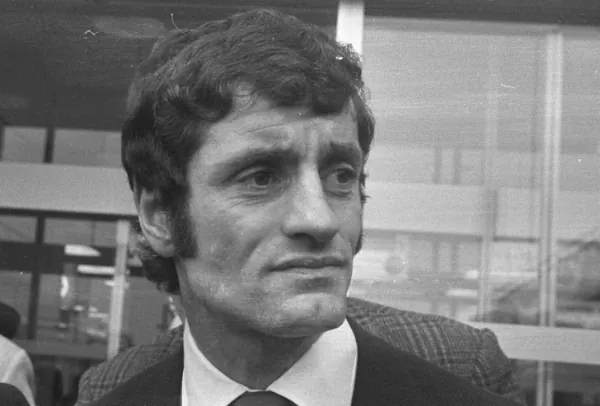
Aged 32 & with plenty of playing years to look ahead to given the longevity of GKs, Wilson however pulled out a surprise. Specifically, he retired from playing as a footballer.
Wilson retired with 308 senior competitive Arsenal first team appearances to his name & to his regret, only 2 Scotland caps. As a metric to put into context how good a GK Bob Wilson was, he is one of the 121 men inducted as players into English football’s Hall of Fame. Further:
- Of those 121 inductees, only 8 are GKs (Wilson’s boyhood hero, Trautmann, is also one of the 8)
- Wilson & McLintock are the only 2 players from that 1971 double winning Arsenal side who are in those 121 inductees
- Of those 121 inductees, Wilson & McLintock are among the select group of only 14 Scots
- Among those 14 Scots, Wilson is the first & only GK
Why did Bob Wilson retire from playing?
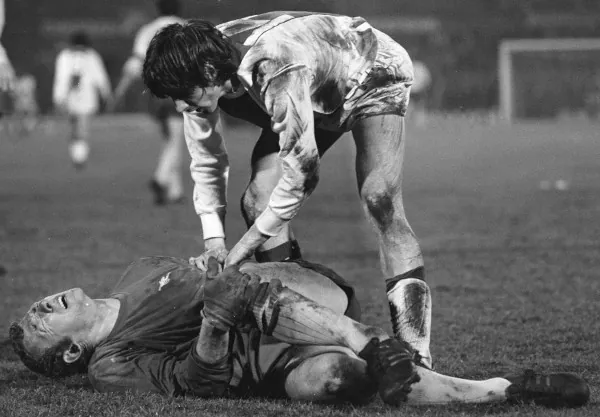
“The trouble was with me. I was like Bert Trautmann, doing everything daftly and head first. All the injuries I have now are around my head and shoulders and I suffered punctured lungs, because I idolised Trautmann.”
For all his on-field courage (going on recklessness), Wilson will have been all too aware how quickly fate can play its hand. His brothers killed in action in WW2, Trautmann’s narrow escape when breaking a neck bone, the Munich air disaster. Even before those, Wilson with his strong Scots heritage will have been acutely aware that 22 year old Celtic & Scotland GK, John Thomson, tragically suffered a fatal skull fracture playing in an Old Firm game. By the Spring of 1974, 32 year old Wilson by now had a wife & 3 kids to support.
“Was I really going to last being 40 or was I going to take this opportunity that will never come along again, as the BBC decided to have a lunchtime program between John Watson [BBC Head of Sport] and myself. We called it Football Focus.”
After playing
TV presenter
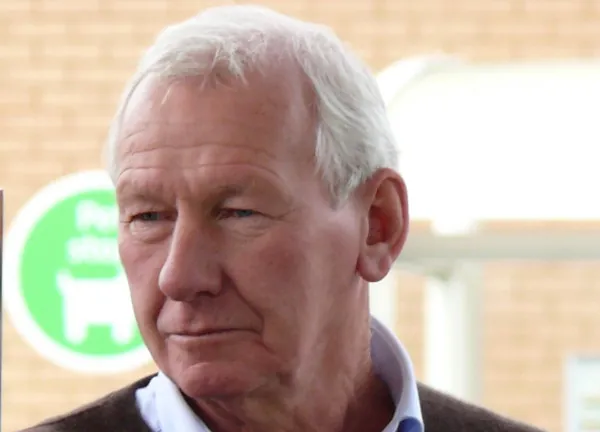
Wilson was ideal for a role in TV presenting. Intelligent, articulate, eloquent, composed, congenial. He had a 28 year career in full-time broadcasting, although not all of it was enjoyable. Wilson was working at Hillsborough in April 1989 when the tragedy unfolded in the crowd there in the FA Cup semi-final. He occasionally returns to TV on an ad hoc basis, & returned as a guest presenter for the final ever edition of Football Focus on 24 May 2026.
Football Coach
In parallel with his TV work, he worked as GK coach at Arsenal for 28 years, capitalising not just on his experience as a GK, but also as a qualified teacher. Before him little consideration had been made for specialised GK coaching.
Charity work
Bob Wilson’s daughter, Anna, in February 1994 when aged 27, was diagnosed with cancer of the nerve sheath (malignant schwannoma). Very sadly, she passed away on 1 December 1998, six days before her 32nd birthday.
Hence, Wilson & his wife, Megs, in 1999 set up the Willow Foundation. As at time of publishing this article, Willow has helped more than 23,500 seriously ill young adults to make magical memories with their families.


.png)

