World Cup 2026 performances against Haiti & Morocco have highlighted the same Scottish major tournament shortcoming. Specifically and going all the way back to 1986, the Scots lack a cutting edge. While that is not entirely down to lacking a top level prolific goalscorer, that is a significant part of the issue. Hence, below we spotlight the 11 greatest Scotland goalscorers in history. All in the list below scored at least 10 SMNT goals. Additionally, all other than the last name in the list, have at least a 50% goals per game strike rate, for the Scotland Men’s National Team (SMNT).
John Smith
| Born | Mauchline, 1855 |
| Clubs | Mauchline FC, Edinburgh University, Queen’s Park |
| SMNT career | 1877-84 |
| SMNT caps | 10 |
| SMNT goals | 10 |
| SMNT goals per game | 1.0 |
The first of the greatest Scotland goalscorers we list, is from the fledgling days of international football. Scotland were the team to beat. Successfully developing a football style based on passing & team work rather than individuality & dribbling, the ‘Scots professors’ were the leading players in what was to become the world game.
Smith played for his home town club when he gained his Scotland debut in 1877. Further, by 1879 he was world’s leading international goalscorer. 7 of Smith’s 10 Scotland goals were against England. Hence unsurprisingly, he was considered the best inside-forward in Britain.
Subsequently, his international career was brought to an abrupt end, aged 29. Despite his excellent reputation as a footballer, he was banned by the SFA from playing in & for Scotland. That was after he guested for Corinthians in England against a professional club, thus breaching the SFA’s amateur statutes.
Impressively multi-talented Smith also played rugby including for Edinburgh Wanderers, & toured overseas with the British Lions. Additionally, he was a practising physician in Kirkcaldy.
George Ker
| Born | Glasgow, 1860 |
| Clubs | Queen’s Park Juniors, Kerland, Alexandra Athletic, Queen’s Park |
| SMNT career | 1880-82 |
| SMNT caps | 5 |
| SMNT goals | 10 |
| SMNT goals per game | 2.0 |
Ker was a teammate of Smith at both Queen’s Park & from 1880-82, also for Scotland. Like Smith, Ker scored 10 Scotland goals including 7 against England. However Ker, eye-poppingly only needed 5 games to do so. However, Ker struggled with injuries before retiring from football aged 24 in the Summer of 1884 when emigrating to USA.
Bob McColl
| Born | Glasgow, 1876 |
| Clubs | Queen’s Park, Newcastle United, Rangers |
| SMNT career | 1896-1908 |
| SMNT caps | 13 |
| SMNT goals | 13 |
| SMNT goals per game | 1.0 |
McColl debuted for Scotland when on the books at Queen’s Park. McColl matched Smith by averaging exactly a goal per game for Scotland. In McColl’s case that equates to 13 strikes in 13 games. He is the only Scotsman to score a hat-trick against each of England, Ireland & Wales.
Robert Smyth McColl later gave his name to his newsagent & confectionery business, RS McColl. In World War I he became a sergeant in the Royal Army Service Corps. He is a Scottish Football Hall of Fame inductee, all the more impressive given how such honours favour recent players.
Robert Hamilton
| Born | Elgin, 1877 |
| Clubs | Elgin City, Queen’s Park, Rangers, Fulham, Heart of Midlothian, Morton, Dundee |
| SMNT career | 1899–1911 |
| SMNT caps | 11 |
| SMNT goals | 15 |
| SMNT goals per game | 1.36 |
Hamilton was a team mate of McColl at Queen’s Park & also for Scotland. In his prolific goal scoring for club (especially Rangers for whom he is an all-time great) & country, he was renowned for his long range shooting accuracy.
Similarly, Hamilton matched Ker by hitting double figures for Scotland & averaging better than a goal per game. Hamilton’s included 4 in Scotland’s 1901 all time record 11-0 win over Ireland.
Additionally, Hamilton was a graduate of Glasgow University who subsequently became a teacher. Further, he became a town councillor in Elgin for 23 years, the last 6 of which he was town Provost.
Andy Wilson
| Born | Newmains, 1896 |
| Clubs | Cambuslang Rangers, Middlesbrough, Hamilton Academical, Leeds City, Heart of Midlothian, Dunfermline Athletic, Chelsea, Queen’s Park Rangers, Sporting Nîmois |
| SMNT career | 1920-1923 |
| SMNT caps | 12 |
| SMNT goals | 13 |
| SMNT goals per game | 1.08 |
Wilson was a genuinely extraordinary character. His left hand & forearm were shattered in World War I by enemy fire at Arras. Subsequently, he wore a glove to mask his injuries. Despite that he was an internationalist in football (for Scotland) and bowls (for England). Also, he made century breaks in snooker & had a single figure golf handicap.
Intelligent & skilful, he scored 32 goals in 33 games guesting for Hearts in 1918/19. He joined Dunfermline Athletic for the resumption of ‘normal’ football in the Autumn of 1919, after the end of World War I. He was with the Pars when he debuted for Scotland in 1920.
His 13 goals in 12 games in 4 years from 1920 to 1923 helped Scotland win successive British Home Championships in the last 3 of those years. The CF spot though was soon taken over by the most astoundingly skilful attacking genius in the history of UK Football, Hughie Gallacher.
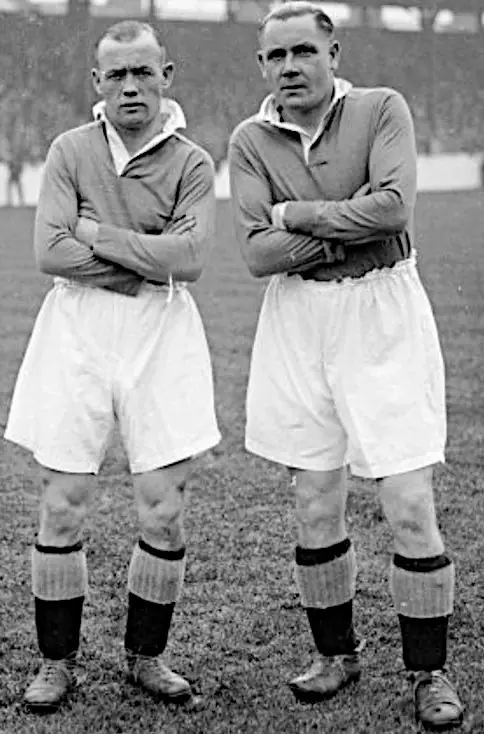
Hughie Gallacher
| Born | Bellshill, 1903 |
| Clubs | Bellshill Athletic, Queen of the South, Airdrieonians. Newcastle United, Chelsea, Derby County, Notts County, Grimsby Town, Gateshead |
| SMNT career | 1923-35 |
| SMNT caps | 20 |
| SMNT goals | 24 |
| SMNT goals per game | 1.2 |
The UK’s 1st football icon
Hughie Gallacher’s football skills stand comparison to the likes of Diego Maradona & Ronaldinho. He was also the portender of the future of footballers living in a media spotlight, the very 1st icon in UK football.
Remembered for his magic feet, his beyond-astonishing ball skills allowed him to beat opponents with a minimum of space. Additionally, Gallacher possessed rocket shooting with either foot. Despite his diminutive stature (5 foot 5), tremendous spring combined with good timing and a doggedly tenacious competitive streak, also made him dangerous with his head.
Gallacher for Scotland
Gallacher debuted for Scotland in 1923 in his days as star man of easily the greatest ever Airdrie side; 3 times Scottish League runners-up and 1924 Scottish Cup winners.
Gallacher’s SMNT form made him undroppable, blitzing 24 goals from 20 Scotland internationals. Consequently, the highest goalscorer in Scottish domestic football history, Celtic’s Jimmy McGrory, was restricted to only 7 SMNT caps. McGrory for his part did the business when given the chance for Scotland; he scored 6 goals in those 7 games.
Further, Gallacher was not only a great goalscorer (and provider). He also scored great goals, often of jaw dropping instinctive imagination & difficulty. His personal favourite of his over 400 senior career goals, was one of his goals for Scotland.
Specifically, he burst towards the Welsh goal on one of his swerving runs. 5 defenders stood between him and the goal. Gallacher swerved past Fred Keenor. Next, Moses Russell attempted to block. However, Gallacher was too quick for him. Another defender sped up to Gallacher. Gallacher though stopped dead in his tracks, bewildering the onrushing defender. Bert Gray running out from goal, desperately dived at the ball near Gallacher’s right foot. Gallacher lifted the ball over Gray, rounded him, and tapped in with his left. “As I turned to walk back I saw the Welsh players applauding me.”
Gallacher in England
Regrettably, Gallacher’s caps & goals tally were impacted for 4 years by the English Football League. Specifically, they placed a block on their clubs releasing players to play for national associations, other than for the English FA. Gallacher was one of 2 players at the centre of events leading to the ban, after Newcastle United pressured him to withdraw from a Scotland squad to instead play club football. At the time, 27-year-old Gallacher had 24 goals from 18 full Scotland internationals; 1.33 goals per game.
Gallacher was one of the 2 most prominent Scots of their generation in English football. Amazingly the other was his great lifelong friend from their days at Bellshill Academy together, midfield pass maestro Alex James. Further ironically, James at Arsenal was the other player at the centre of the storm that led to the ban mentioned above.
Both of them are in not just the Scottish Football Halls of Fame, but also among the only 14 Scots in the English Football Hall of Fame. Gallacher remains 3rd on the SMNT all time goal scoring list.
Tragedy
Hughie Gallacher took his own life in 1957, a tragic end for an all time great football genius.*
Lawrie Reilly
| Born | Edinburgh, 1928 |
| Clubs | Hibernian |
| SMNT career | 1948-57 |
| SMNT games | 38 |
| SMNT goals | Disputed, either 22 or 23 |
| SMNT goals per game | Either 58 or 61% |
Reilly at Hibs
Despite Matt Busby asking him to transfer to Manchester United, Reilly only wanted to play club football for Hibernian. He was the CF of the Hibs ‘Famous Five’ forward line of the late 40s & early 50s. Reilly won 2 Scottish league titles with Hibs and scored 2 goals as Hibs reached the semi-finals of 1955-56 inaugural European Cup. Like Gallacher, he was deadly with both feet & also very successful in the air for a relatively short man.
At 5 foot 7, Reilly wasn’t a big guy. However, as well as Reilly’s prolific goalscoring, valuable insight into Reilly’s on field talents come from the strongman enforcer of that Hibs forward line, inside-forward Eddie Turnbull. Turnbull stated that in the robust, uncompromising world of Scottish football of that era, he had to ‘look after’ 3 of the other 4 forwards in that forward line. However, Turnbull stated that the fearless Reilly looked after himself, unneedy of Turnbull to impose retribution on Reilly’s direct opponents.
Reilly for Scotland
Reilly like some others in this list, had a particularly happy habit of scoring against England. The Scottish Football Museum credit him with 6 goals in 7 games against the Auld Enemy.
Reilly’s total Scotland goals tally is disputed. At time of writing, most websites including the SFA website, currently credit him with 22 Scotland goals. However and despite 22/38 = 58%, the same page on the SFA website credits Reilly with a 61% goals per game ratio. 61% equates to the 23 goals in 38 games currently listed on the Scottish Football Museum website. Reilly’s tally might have been higher, but for what is arguably the greatest blunder in the history of Scottish football officialdom.
Specifically, Reilly was the established CF when Scotland as runners-up in the British Home Championship, qualified for the 1950 World Cup finals in Brazil. However, incredibly the SFA refused to send a team, since they had only qualified as runners-up.
Subsequently, Scotland qualified for the 1954 World Cup in Switzerland. However, this time Reilly missed out after coming down with pleurisy. Scotland also qualified for the 1958 finals. However, Reilly had played his last Scotland game the year before, being impacted by an increasingly troublesome knee injury.
Consequently, that injury caused his early retirement from football aged 29, in 1958. Hibs offered him a directorship. Reilly declined to instead run a pub in Leith, a minor irony given his tee-totality. He is a Scottish Football Hall of Fame inductee.
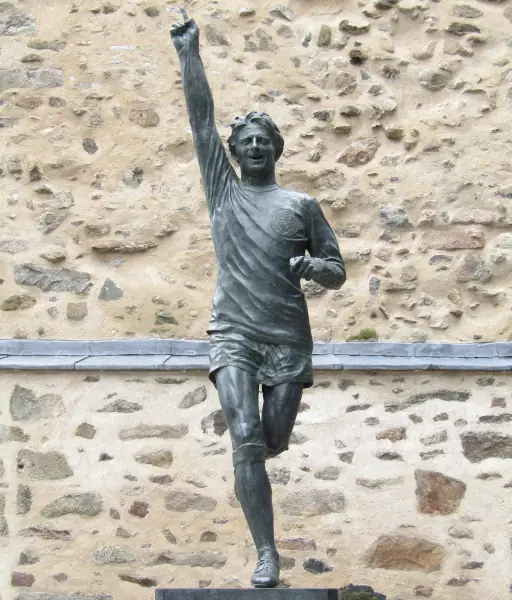
Denis Law
| Born | Aberdeen, 1940 |
| Clubs | Huddersfield Town, Manchester City, Torino, Manchester United |
| SMNT career | 1958-74 |
| SMNT caps | 55 |
| SMNT goals | 30 |
| SMNT goals per game | 0.55 |
From poverty to Ballon D’or
To many, the greatest Scotland goalscorer of all time is Denis Law. Young Law was offered a place at Aberdeen Grammar School. Despite coming from an impoverished background, he turned it down because there they played rugby rather than football.
Subsequently, Law was at Huddersfield Town when he debuted for Scotland in Autumn 1958, managed by Matt Busby who was temporary Scotland boss. Law was quick, brave, fearless and had whippet-like reactions. For all of his prowess as a goalscorer, he unselfishly always passed when a teammate was available in a better position. He initially played at inside-forward.
Law joined Torino in 1961 becoming the first Scotsman to play in the Italian football championship since its 1929 re-brand to Serie A. Lightning speed Hibs goal machine, Joe Baker, joined at the same time. Baker though, son of a merchant seaman, was born in Liverpool & thus deemed English under football regulations of the day. That was despite Baker spending all but the first 6 weeks of his childhood living in Scotland. Neither Law nor Baker enjoyed football in Italy. Both moved to England in under a year, where each of them scored prolifically.
Specifically in Law’s case, he signed for Matt Busby at Manchester United in 1962. It was Busby who moved Law from inside-forward to CF. Fiercely competitive Law disliked the move, preferring the greater involvement in the game offered at inside-forward. He is though best remembered from his newly deployed position at the spear tip of the attack.
Law was prolific for club & country. In his first 40 Scotland games, he scored 28 goals; a 0.7 goals per game strike rate. Testament to Law’s exceptional football talents, in 1964 he became the only Scotsman to date to win the Ballon D’or.
Injuries take their toll
However, in October 1965 playing for Scotland against Poland, he injured his previously operated on right knee. Further, he saw a specialist in 1968 who reported to United that Law’s knee again needed an operation. Law was not shown the report until years after, instead playing on often with cortisone injections, further damaging the knee.
He re-injured the knee again in 1968, causing him to miss the semi-final & final Man Utd won the European Cup. In his subsequent 15 Scotland games after that time out with injury, Law scored only 2 goals. His last game in professional football was his World Cup debut. Scotland won 2-0 against Zaire in 1974. Scotland were eliminated at the group stage despite being unbeaten in their 3 games.
Like Gallacher, Denis Law is in both the Scottish & English football Halls of Fame. After retiring as a player, Law became involved in punditry.
Alan Gilzean
| Born | Coupar Angus, 1938 |
| Clubs | Dundee, Tottenham Hotspur, Highlands Park |
| SMNT career | 1963-71 |
| SMNT caps | 22 |
| SMNT goals | 12 |
| SMNT goals per game | 0.54 |
Goal scoring machine
Gilzean was a prolific CF of the superb Dundee side who were 1962 Scottish League champions. Extraordinary as it sounds, Gilzean & co the season after in the European Cup eliminated FC Köln, Sporting CP & Anderlecht, all by at least 2 aggregate goals. Subsequently, they were eliminated in the semis by eventual winners, AC Milan.
For all of Gilzean’s Dundee goals in Scotland & 8 in that European Cup run, he didn’t debut for Scotland until aged 25 in November 1963. Gilzean possessed excellent technique, & was especially noted for his heading proficiency. Gilzean played together with Law 9 times for Scotland, formidably sharing 11 goals between them (5 for Law & 6 for Gilzean). In a minor irony for such a potent strike force, they never both scored in any of those 9 games. i.e., Gilzean didn’t score when Law scored & Law didn’t score when Gilzean scored.
Goal providing machine
Gilzean transferred to Tottenham Hotspur in December 1964. Paired initially with Jimmy Greaves & later with Martin Chivers in attack, Gilzean became known as the King of White Hart Lane. Gilzean adapted his game to primarily be the provider partnering a penalty box striker in attack. Greaves’ 357 goals in England’s top tier remains a record to this day. Greaves, grateful for the service he was given, stated Gilzean was the best player he ever played with. Gilzean’s trophy wins with Spurs included the UEFA Cup in 1972.
Gilzean scored 11 of his 12 SMNT goals in his first 15 games. His international strike rate unsurprisingly tailed off later in his career as he was decreasingly used as a primary goal grabber. Instead he was provider for the likes of Colin Stein.
Unusually for such a gifted & successful footballer, Gilzean stated that he disliked football. After retiring as a player he forged a new career in the transportation sector. He is a Scottish Football Hall of Fame inductee.
Kenny Dalglish
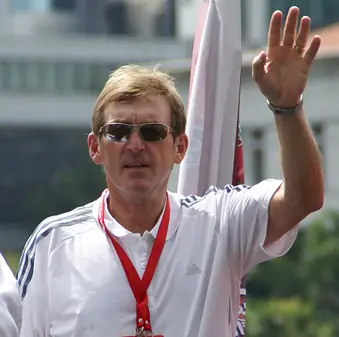
| Born | Glasgow, 1951 |
| Clubs | Celtic, Liverpool |
| SMNT career | 1971-86 |
| SMNT caps | 102 |
| SMNT goals | 30 |
| SMNT goals per game | 0.29 |
Dalglish for Scotland
The last of the greatest Scotland goalscorers we list, is the only player in this list without an SMNT goals per game ratio of at least 0.5. However, Kenny Dalglish is included in this list:
- Since he is equal record SMNT goalscorer along with Law on 30 goals
- As an excuse to provide a link to this video compilation of his SMNT goals.
Choose a favourite for yourself. The flashing header in the cauldron of the World Cup qualifier against Wales at Anfield? The double turn and finish away to Belgium? Or the cut inside and left foot drive into the top corner when defeating Spain 3-1 at Hampden?
Dalglish is yet another in this list gifted with wonderful football intelligence, combined with lethality with both feet. A wonderfully versatile attacking player, Dalglish initially played for Celtic at right-half (deep lying MF in today’s talk), before moving primarily to inside-left. Furthermore, he eventually moved to CF in 1975. Jock Stein memorably in 1977 remarked of Dalglish, “Is he better in midfield or up front? Och, just let him on the park.”
Like Gilzean, Dalglish later effortlessly adapted his game when needed to play as a creative forward feeding a razor sharp penalty box striker. Most prominently in Dalglish’s case, that was supporting the deadly clinical shooting of Ian Rush at Liverpool. Among the strikers Dalglish played beside for Scotland were Joe Jordan & Mo Johnston.
Dalglish played for Scotland in the 1974, 78, & 82 World Cups. He scored once in each of the latter 2 competitions, against Netherlands & New Zealand respectively. He was lined up to also play at Mexico ’86 but withdrew through injury.
Other achievements
Among his trophy packed playing career, he won 3 European Cups with Liverpool. Still their greatest ever player, he scored the only goal in the 1978 final win against Club Brugge.
Dalglish was 1983 Ballon D’or runner-up to Michel Platini. He is the 3rd player in this list in both the Scottish & English football Halls of Fame.
After retiring as a player, he had a trophy winning career in football management. Along with his wife Marina, he has helped raise over £13m to improve the lives of people fighting cancer.
Get well soon Kenny
On 2nd June 2026, Dalglish unintentionally disclosed that he himself is undergoing cancer treatment. Fitba.scot wishes Dalglish a full and speedy recovery.
* There’s no shame in mental illness. Anyone who needs some support, options available include: